

Blog

How to Choose the Right Circuit Breaker: An Expert Guide for Electrical & Industrial Customers

How to Choose the Right Circuit Breaker: An Expert Guide for Electrical & Industrial Customers
Create a full-bleed professional infographic in a 3:2 aspect ratio with a clean industrial style, white background, dark navy and electric blue accents, subtle gray lines, and modern sans-serif typography.

Top section: large bold heading centered across the top reading "How to Choose the Right Circuit Breaker" with a smaller subtitle beneath it reading "An Expert Guide for Electrical & Industrial Customers". Place a small blue circuit breaker icon to the left of the heading.

Below the title, include a short intro text block in a wide banner:
"Picking the wrong circuit breaker can shut down operations, damage equipment, or create serious safety hazards."

Main content area: arrange three wide horizontal sections or three equal columns across the page, each with a numbered blue circle icon and a clear visual symbol.

Section 1 on the left:
Numbered circle "1" with a breaker/device icon.
Heading: "Choose the Right Type"
Body text: "Match the breaker type to your application and where it fits in the system."
Add small sub-icons for industrial panel, motor, and commercial equipment.

Section 2 in the center:
Numbered circle "2" with a voltage and amperage gauge icon.
Heading: "Match Voltage & Amperage"
Body text: "Check actual voltage and amperage needs before selecting a breaker rating."
Add a simple visual scale or meter labeled "Voltage" and "Amperage".

Section 3 on the right:
Numbered circle "3" with a checklist and shield icon.
Heading: "Verify Specs & Compliance"
Body text: "Review technical specifications and compliance standards before placing an order."
Add small checkmarks and a certification-style badge icon.

Bottom section: a wide concluding callout box with a bold blue border and a checkmark icon, containing the text:
"No fluff. Just the information you need to make a confident, well-informed purchase."

Use strong visual hierarchy, crisp spacing, clean alignment, and minimal decorative elements. Keep text sharp, legible, and exactly as written. Avoid any photo background, people, or clutter.

How to Choose the Right Circuit Breaker: An Expert Guide for Electrical & Industrial Customers

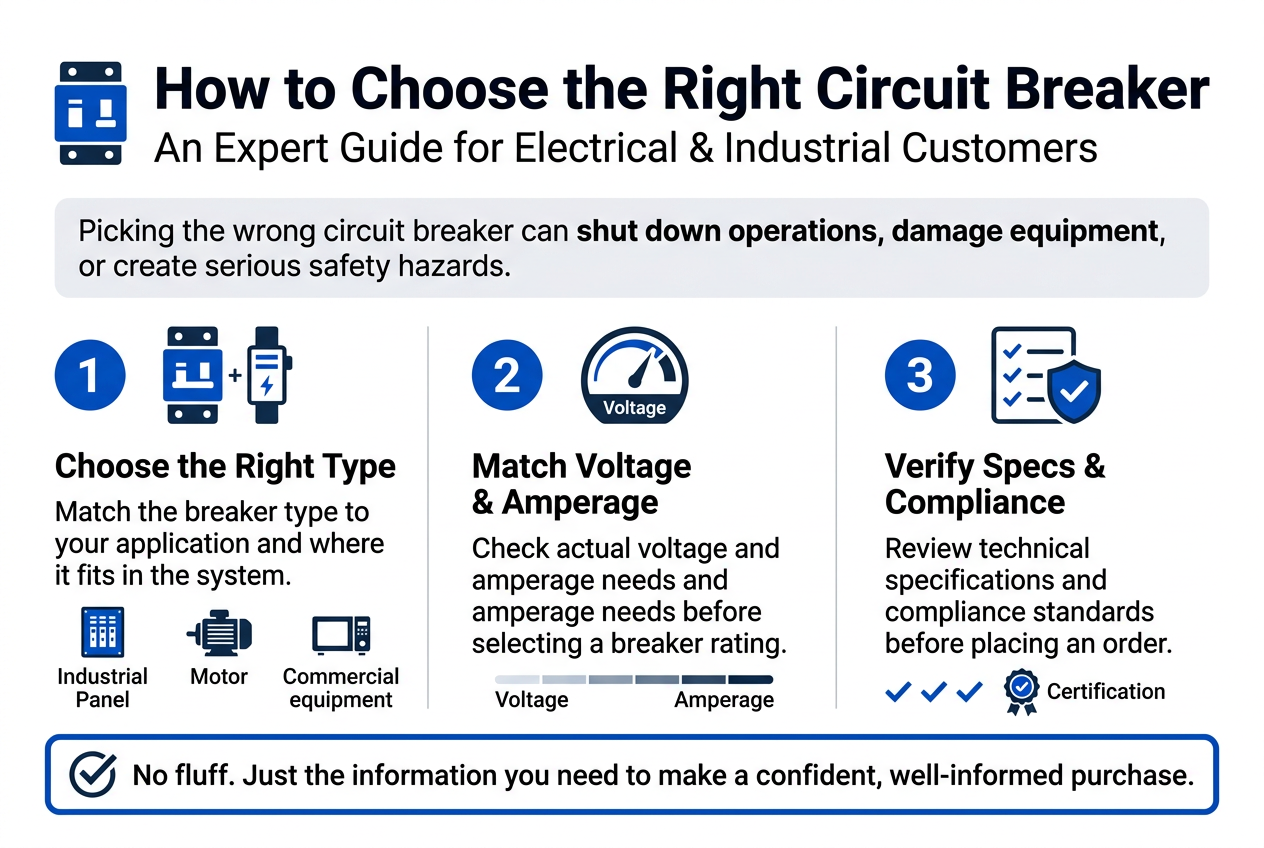
Picking the wrong circuit breaker doesn’t just cause headaches — it can shut down operations, damage equipment, or create serious safety hazards. If you’re an electrician, facility manager, or industrial buyer sourcing breakers for a commercial or industrial setup, getting this decision right matters.

This guide cuts through the confusion and gives you a clear, practical path to choosing the right circuit breaker for your application. We’ll walk you through the different types of circuit breakers available and where each one fits, how to match breaker ratings to your actual voltage and amperage needs, and what technical specs and compliance standards you should check before you ever place an order.

No fluff. Just the information you need to make a confident, well-informed purchase.

+ Add Section

Understanding the Core Function of a Circuit Breaker
Create a clean, professional full-bleed infographic in a 3:2 aspect ratio with a modern electrical engineering style. Use a white background with deep navy, electric blue, teal, and safety orange accents. Use bold sans-serif typography, strong hierarchy, thin divider lines, and flat vector icons. Layout should be wide and horizontal with three main sections across the canvas, not a vertical poster.

TOP HEADER ACROSS FULL WIDTH:
Large bold title in dark navy: "Understanding the Core Function of a Circuit Breaker"
Smaller subtitle beneath in medium blue: "How Circuit Breakers Protect Your Electrical System"

LEFT SECTION: "1. How Circuit Breakers Protect"
Include a large illustration of a circuit breaker panel with one breaker switch flipping to OFF, a glowing lightning bolt, and a shield icon. Add three small icon bullets below:
- "Overload"
- "Short circuit"
- "Ground fault"
Add short body text in a neat text block:
"A circuit breaker acts as your electrical system's safety valve."
"When current exceeds a safe threshold, the breaker trips and cuts power."
"Modern breakers detect faults in milliseconds."
Use a small fire prevention icon and a stop symbol near the text.

CENTER SECTION: "2. Circuit Breaker vs Fuse"
Create a clean comparison block split into two columns with icons at the top: a reset switch for circuit breaker and a fuse link for fuse.
Use a table-like layout with these exact labels and values:
"Reset" | "Manually reset" | "Must be replaced"
"Response Time" | "Slightly slower" | "Extremely fast"
"Cost Over Time" | "Lower" | "Higher (recurring)"
"Best For" | "General protection" | "High-precision fault protection"
Add a subtle note at the bottom of this section:
"Fuses react faster, which matters in sensitive electronics."
"Breakers win on convenience and reusability."
Use blue for circuit breaker column and orange for fuse column.

RIGHT SECTION: "3. Choosing the Right Breaker"
Use a warning-style panel with a checklist icon and three caution symbols. Include four stacked callouts with bold labels:
"Nuisance tripping" — "from an unders

How Circuit Breakers Protect Your Electrical System

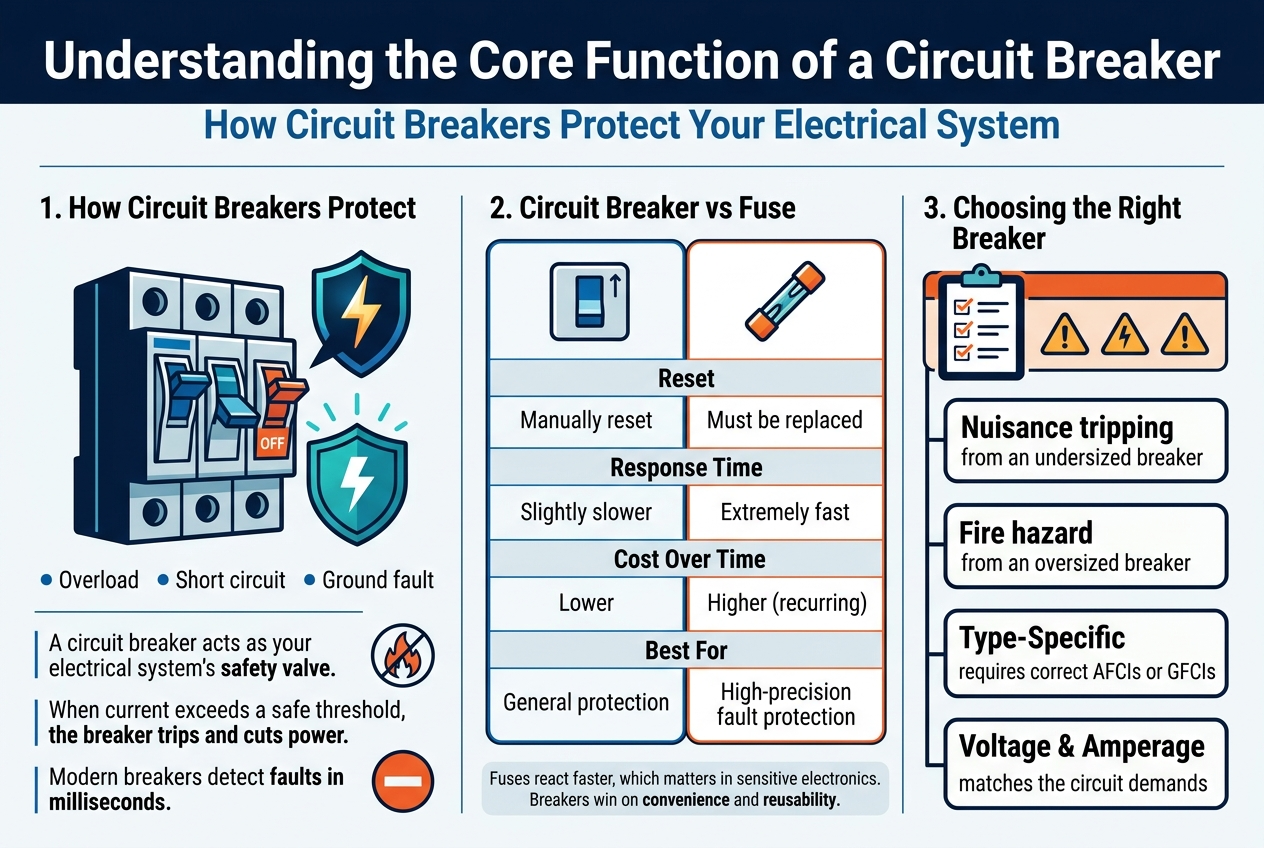
A circuit breaker acts as your electrical system’s safety valve. When current exceeds a safe threshold — whether from an overload, short circuit, or ground fault — the breaker trips and cuts power before heat or arcing can damage wiring, equipment, or worse, start a fire.

Modern breakers detect faults in milliseconds, making them a critical line of defense in both residential panels and industrial switchgear.

Key Differences Between Circuit Breakers and Fuses

Feature

Circuit Breaker

Fuse

Reset

Manually reset

Must be replaced

Response Time

Slightly slower

Extremely fast

Cost Over Time

Lower

Higher (recurring)

Best For

General protection

High-precision fault protection

Fuses react faster, which matters in sensitive electronics. Breakers win on convenience and reusability — that’s why they dominate most modern installations.

Why Choosing the Wrong Breaker Puts Your System at Risk

Getting the wrong breaker isn’t just an inconvenience — it can be dangerous. Common problems include:

  • Nuisance tripping from an undersized breaker
  • Undetected overloads from an oversized one
  • Equipment damage if the interrupt rating doesn’t match available fault current
  • Code violations that void insurance coverage

The right breaker has to match your system’s voltage, amperage, and fault current — not just what fits the panel slot.

+ Add Section

Identifying the Different Types of Circuit Breakers
Create a clean professional infographic illustration in a full-bleed 3:2 landscape layout with a modern engineering style, white background, navy blue, teal, orange, and gray accents, crisp sans-serif fonts, strong hierarchy, and clear section dividers.

Top header spanning full width:
Bold title text: "Identifying the Different Types of Circuit Breakers"
Add a subtle electrical breaker panel icon near the title.

Below the title, arrange the content in a wide 2-row layout with multiple horizontal sections, not a vertical poster.

Left top section: a large block labeled "Standard Single-Pole and Double-Pole Breakers for Common Applications" with two side-by-side cards.
Card 1: blue icon of a single switch breaker, heading "Single-pole breakers", and text "120V circuits", "15A to 30A", "Outlets, lighting, small appliances"
Card 2: orange icon of a double switch breaker, heading "Double-pole breakers", and text "240V loads", "15A to 200A", "Dryers, water heaters, HVAC equipment"

Right top section: a safety block labeled "GFCI and AFCI Breakers for Enhanced Safety" with two side-by-side cards.
Card 3: green icon with a ground fault symbol, heading "GFCI breakers", and text "Detect ground faults", "Cuts power within milliseconds", "Kitchens, bathrooms, garages, outdoor areas"
Card 4: red icon with a spark/arc symbol, heading "AFCI breakers", and text "Detect dangerous arc faults", "Damaged or deteriorating wiring", "Bedrooms and living areas per NEC guidelines"

Middle left section: a bold industrial block labeled "Molded Case Circuit Breakers for Industrial Use" with a heavy-duty breaker icon, and text "MCCBs", "Up to 2,500A", "Adjustable trip settings", "Motor control centers, distribution panels, heavy equipment protection"

Bottom wide section: a comparison table titled "Air, Vacuum, and Oil Circuit Breakers for High-Voltage Environments" with three columns and clean grid lines.
Column headers: "Type", "Interrupting Medium", "Best For"
Row 1: "Air" | "Compressed air" | "Medium-voltage switchgear"
Row

Standard Single-Pole and Double-Pole Breakers for Common Applications

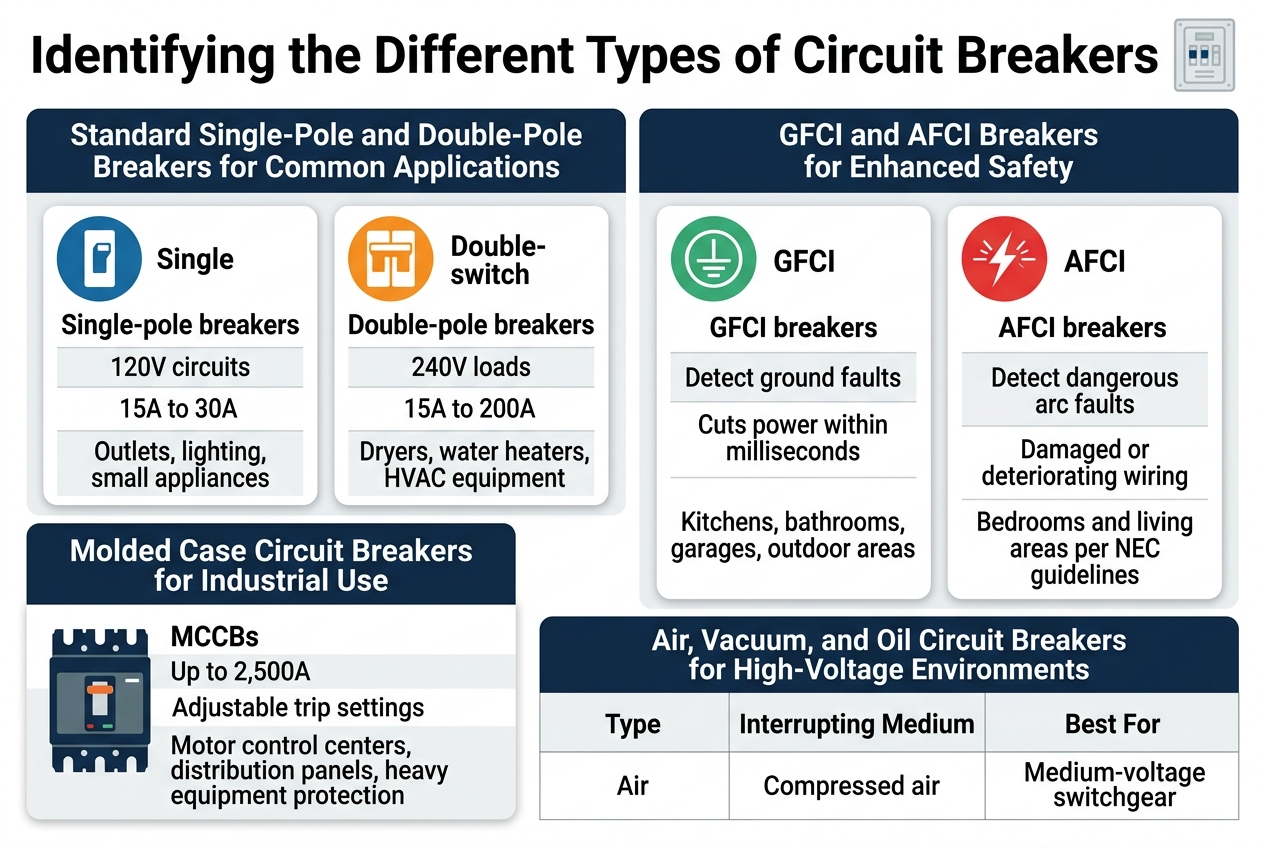
These are the breakers you’ll find in almost every home and light commercial building.

  • Single-pole breakers handle 120V circuits and typically range from 15A to 30A — perfect for outlets, lighting, and small appliances
  • Double-pole breakers cover 240V loads like dryers, water heaters, and HVAC equipment, ranging from 15A to 200A

GFCI and AFCI Breakers for Enhanced Safety

Both add a critical layer of protection beyond basic overcurrent defense.

  • GFCI breakers detect ground faults and cut power within milliseconds — required in kitchens, bathrooms, garages, and outdoor areas
  • AFCI breakers catch dangerous arc faults caused by damaged or deteriorating wiring, now mandatory in most bedroom and living area circuits per NEC guidelines

Molded Case Circuit Breakers for Industrial Use

MCCBs handle higher current ratings (up to 2,500A) and offer adjustable trip settings — a solid choice for motor control centers, distribution panels, and heavy equipment protection.

Air, Vacuum, and Oil Circuit Breakers for High-Voltage Environments

Type

Interrupting Medium

Best For

Air

Compressed air

Medium-voltage switchgear

Vacuum

Vacuum interrupter

Utility and industrial substations

Oil

Insulating oil

Older high-voltage installations

Vacuum breakers dominate new high-voltage installations today due to their low maintenance needs and reliable arc-quenching performance.

+ Add Section

Matching the Right Breaker to Your Voltage and Amperage Requirements
Create a clean professional landscape infographic in a 3:2 aspect ratio, full-bleed with no poster frame, using a white background, dark navy headings, teal and orange accents, and crisp sans-serif typography.

Top center: large bold title in dark navy text: "Matching the Right Breaker to Your Voltage and Amperage Requirements"

Below the title, divide the layout into three wide horizontal sections with clear headers and simple electrical-themed icons.

LEFT SECTION, top half: 
Header in teal with a calculator icon: "How to Calculate the Load Capacity Your System Demands"
Show a simple formula block with bold text: "Amps = Watts ÷ Volts"
Below it, a small line of body text: "Add up the wattage of every device on the circuit, then divide by voltage to get amperage:"
Include a warning badge icon and a highlighted note in orange: "Always build in a 25% safety buffer"
Add a second emphasized line: "A 20A breaker should carry no more than 16A continuously."

CENTER SECTION, top half:
Header in teal with a breaker-switch icon: "Selecting the Correct Amperage Rating to Prevent Overloads"
Create a clean 3-column reference table with thin gray lines and row icons:
Column headers: "Application" "Typical Load" "Recommended Breaker"
Rows:
"Lighting circuits" | "1,200W" | "15A"
"Kitchen appliances" | "2,400W" | "20A"
"HVAC systems" | "7,200W" | "30–60A"
"Industrial motors" | "Varies" | "100A–400A+"
Under the table, add a small wire icon and a bold note in orange: "A 20A breaker needs at least 12 AWG wiring"

RIGHT SECTION, top half:
Header in teal with a voltage bolt icon: "Understanding Voltage Ratings for Residential vs. Industrial Applications"
Use three stacked horizontal callout bars with icons:
Residential with a house icon: "Typically 120V (single-phase) or 240V for heavy appliances"
Commercial with a building icon: "Usually 208V or 240V three-phase"
Industrial with a

How to Calculate the Load Capacity Your System Demands

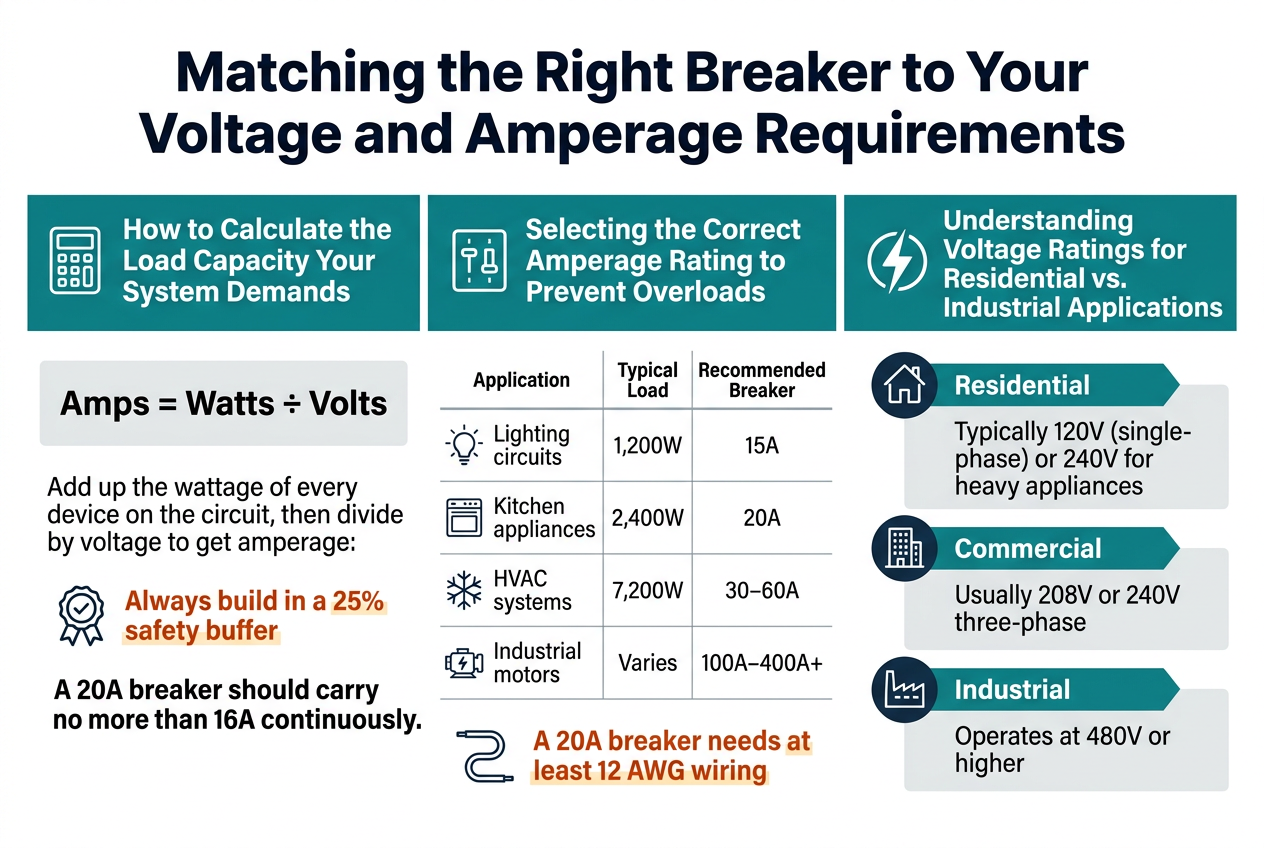
Add up the wattage of every device on the circuit, then divide by voltage to get amperage:

Amps = Watts ÷ Volts

Always build in a 25% safety buffer — a 20A breaker should carry no more than 16A continuously.

Selecting the Correct Amperage Rating to Prevent Overloads

Choosing the wrong amperage is one of the most common (and costly) mistakes. Here’s a quick reference:

Application

Typical Load

Recommended Breaker

Lighting circuits

1,200W

15A

Kitchen appliances

2,400W

20A

HVAC systems

7,200W

30–60A

Industrial motors

Varies

100A–400A+

Match the breaker to the wire gauge too — a 20A breaker needs at least 12 AWG wiring.

Understanding Voltage Ratings for Residential vs. Industrial Applications

Voltage requirements differ significantly across settings:

  • Residential: Typically 120V (single-phase) or 240V for heavy appliances
  • Commercial: Usually 208V or 240V three-phase
  • Industrial: Often 480V or 600V three-phase for motors and heavy machinery

Never install a breaker rated below your system voltage — it won’t interrupt faults safely and creates serious fire and arc-flash risks.

+ Add Section

Evaluating Key Technical Specifications Before You Buy
Create a clean professional infographic in a 3:2 aspect ratio, full-bleed layout with no border, no poster frame, and no large empty margins. Use a modern industrial style with dark navy, steel blue, white, and orange safety accents. Use bold sans-serif typography, strong hierarchy, and clear section blocks arranged in a wide 2-row layout with multiple columns instead of a vertical stack.

Top header spanning full width:
Bold title in large white text on a dark navy bar: "Evaluating Key Technical Specifications Before You Buy"

Below the title, arrange five wide horizontal sections or card blocks across the canvas with matching icons, each with a colored label bar, concise body text, and clean spacing.

Section 1 at upper left:
Orange warning triangle icon.
Heading: "Interrupting Capacity and Why It Matters for Safety"
Body text: "Interrupting capacity (IC) is the maximum fault current a breaker can safely cut off without failing. If fault current exceeds the IC rating, the breaker can arc, explode, or catch fire. Always match IC rating to your system's available short-circuit current."

Section 2 at upper center-right:
Blue lightning bolt and breaker icon.
Heading: "Trip Curve Settings and Their Impact on Equipment Protection"
Include a small 2-column mini-table with visible grid lines:
Column headers: "Curve Type" and "Best For"
Rows:
"B" — "Resistive loads, long cable runs"
"C" — "General-purpose motors, lighting"
"D" — "High-inrush equipment, transformers"
"K/Z" — "Sensitive electronics"
Add a small note beneath in orange text: "Choosing the wrong curve causes nuisance tripping or, worse, delayed protection."

Section 3 across lower left:
Industrial shield icon with a breaker symbol.
Heading: "Short Circuit Withstand Ratings for Industrial Environments"
Body text: "Look for the Ics (service short-circuit capacity) and Icu (ultimate breaking capacity) values. Industrial panels often see high fault levels—a breaker rated too low can fail catastrophically under real fault conditions."

Section 4 lower middle:
Four pole configuration icons shown as small breaker diagrams labeled clearly.
Heading: "Pole Configuration and Its Role in System Compatibility"
Four compact labeled blocks:
"1-pole: Single-phase branch circuits"
"

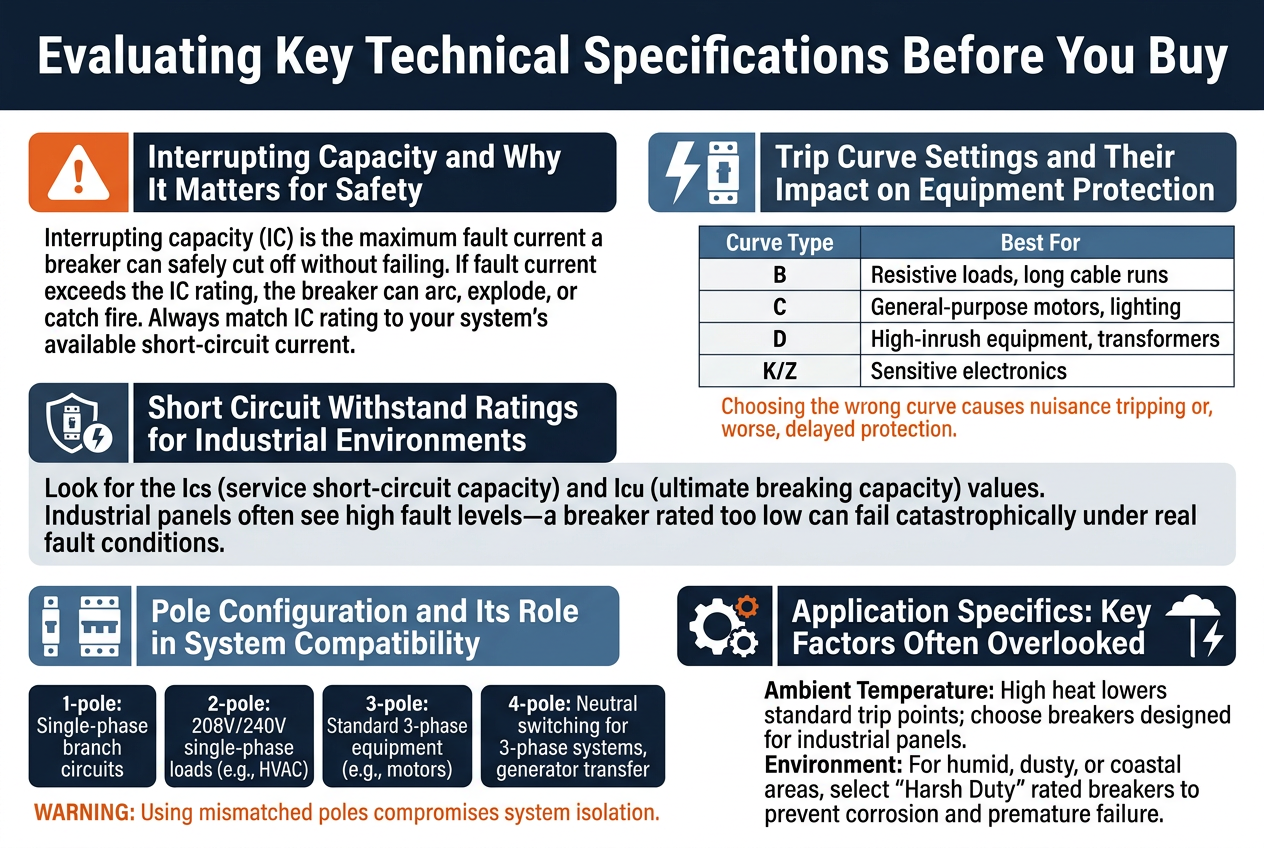
Interrupting Capacity and Why It Matters for Safety

Interrupting capacity (IC) is the maximum fault current a breaker can safely cut off without failing. If fault current exceeds the IC rating, the breaker can arc, explode, or catch fire. Always match IC rating to your system’s available short-circuit current.

Trip Curve Settings and Their Impact on Equipment Protection

Trip curves define how quickly a breaker responds to overcurrent conditions:

Curve Type

Best For

B

Resistive loads, long cable runs

C

General-purpose motors, lighting

D

High-inrush equipment, transformers

K/Z

Sensitive electronics

Choosing the wrong curve causes nuisance tripping or, worse, delayed protection.

Short Circuit Withstand Ratings for Industrial Environments

Look for the Ics (service short-circuit capacity) and Icu (ultimate breaking capacity) values. Industrial panels often see high fault levels—a breaker rated too low can fail catastrophically under real fault conditions.

Pole Configuration and Its Role in System Compatibility

  • 1-pole: Single-phase branch circuits
  • 2-pole: 240V residential/light commercial
  • 3-pole: Three-phase industrial systems
  • 4-pole: Systems requiring neutral protection

IP and Enclosure Ratings for Harsh or Outdoor Environments

For outdoor or wet locations, target IP65 or higher. Dusty industrial environments need at least IP54. Matching the enclosure rating to actual site conditions keeps equipment running and workers safe.

+ Add Section

Navigating Industry Standards and Compliance Requirements
Create a clean professional infographic illustration in a 3:2 aspect ratio, full-bleed layout with no frame, no poster border, and no narrow centered stack. Use a modern industrial style with dark navy, steel blue, light gray, and orange accent colors. Use bold sans-serif fonts for headings and smaller readable sans-serif text for body copy. 

Top center: large bold title text: "Navigating Industry Standards and Compliance Requirements"

Below the title, divide the design into three wide horizontal content sections across the page, each with a distinct icon and color band.

Section 1 on the upper left and upper center: heading text "1. Key Certifications to Look For" with a shield/check icon and four certification blocks arranged in a 2x2 grid. Include the following table-style text in each block:
"UL 489" — "North America" — "Covers molded-case breakers for branch circuits"
"IEC 60947-2" — "International" — "Industrial low-voltage breaker standard"
"ANSI C37" — "North America" — "Focuses on medium/high-voltage switchgear"
"CSA" — "Canada" — "Required for Canadian installations"
Add a small note beneath the grid with a checkmark icon: "Always match the certification to your operating region and application type."

Section 2 across the middle: heading text "2. How Local Electrical Codes Influence Your Breaker Selection" with a clipboard/code icon. Show a left-to-right flow with three labeled callout boxes connected by lines:
"AHJ (Authority Having Jurisdiction) requirements in your area"
"Whether your facility needs AFCI or GFCI protection"
"Specific rules for hazardous locations (NEC Article 500)"
Add a smaller supporting text box to the right with a code-book icon and the text:
"The NEC (National Electrical Code) in the US dictates everything from interrupting capacity to arc-flash labeling requirements. Local amendments can add stricter rules on top of that."

Section 3 across the lower left and lower center: heading text "3. Avoiding Costly Compliance Failures" with a warning triangle icon. Show three red-orange hazard cards with icons and bold labels:
"Installing residential-grade

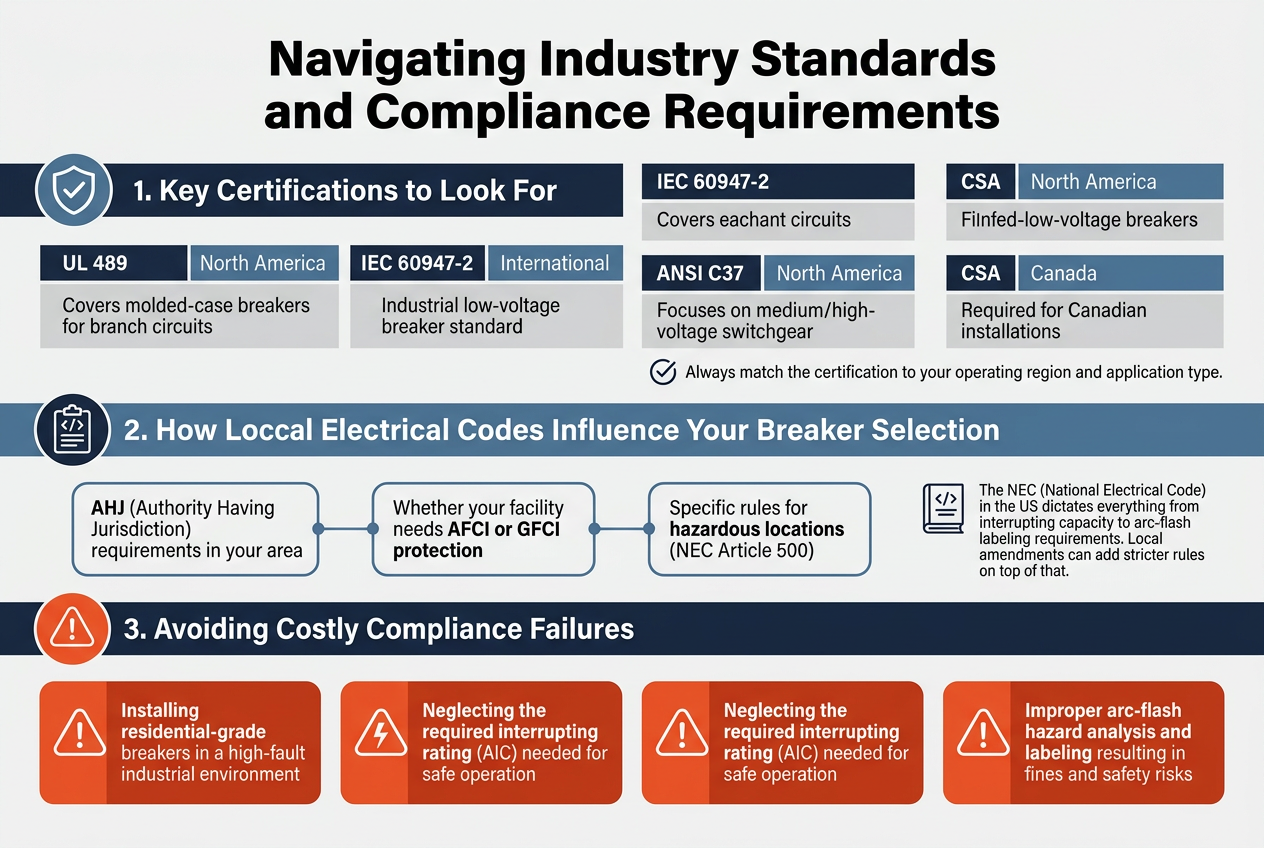
Key Certifications to Look for Such as UL, IEC, and ANSI

Certifications aren’t just bureaucratic checkboxes — they confirm a breaker has survived real-world stress testing.

Certification

Region

Significance

UL 489

North America

Covers molded-case breakers for branch circuits

IEC 60947-2

International

Industrial low-voltage breaker standard

ANSI C37

North America

Focuses on medium/high-voltage switchgear

CSA

Canada

Required for Canadian installations

Always match the certification to your operating region and application type.

How Local Electrical Codes Influence Your Breaker Selection

The NEC (National Electrical Code) in the US dictates everything from interrupting capacity to arc-flash labeling requirements. Local amendments can add stricter rules on top of that. Before purchasing, check:

  • AHJ (Authority Having Jurisdiction) requirements in your area
  • Whether your facility needs AFCI or GFCI protection
  • Specific rules for hazardous locations (NEC Article 500)

Avoiding Costly Compliance Failures in Industrial Installations

Skipping compliance shortcuts your safety margin and your budget. Common failure points include:

  • Installing residential-grade breakers in commercial panels
  • Mismatching interrupting ratings with available fault current
  • Using uncertified counterfeit breakers from gray-market suppliers

Get documentation from your supplier — including test reports and certificates of conformance — before any breaker goes into service.

+ Add Section

Choosing a Reliable Brand and Supplier for Long-Term Value
Create a full-bleed professional infographic in 3:2 aspect ratio with a clean white background, blue and charcoal color palette, and modern sans-serif typography. Use a wide horizontal layout with three main content sections across the page and no vertical poster framing.

Top header across the full width:
Bold title in large dark navy text: "Choosing a Reliable Brand and Supplier for Long-Term Value"
Small subtitle beneath in gray: "Top circuit breaker brands, supplier support, and cost-quality balance"

Section 1 on the left, titled in a blue banner:
"Top Circuit Breaker Brands Trusted by Electrical Professionals"
Include a 5-row brand comparison block with small shield or circuit icons beside each brand name:
- "Schneider Electric — Wide product range, global support"
- "Eaton — Industrial-grade durability"
- "Siemens — Precision engineering, strong compliance"
- "ABB — High-performance commercial/industrial"
- "Square D (Schneider) — Residential and light commercial reliability"
Add a small warning badge nearby with text: "Established manufacturers help reduce counterfeit risk"

Section 2 in the center, titled in a teal banner:
"How to Evaluate Supplier Support, Warranty, and Availability"
Show four numbered checklist cards with clear icons:
1. "Documented warranty terms" with a document and checkmark icon
   Small note: "1–5 years depending on product tier"
2. "Local or regional stock availability" with a warehouse box icon
3. "Technical support access" with phone, email, and headset icons
   Small note: "Phone, email, or on-site"
4. "Authorized distributor status" with a verified seal icon
Use connected lines or arrows between cards in a horizontal flow.

Section 3 on the right, titled in an orange banner:
"Balancing Cost Against Quality to Protect Your Investment"
Show a visual comparison with two side-by-side boxes:
Left box with a red price tag icon and text:
"Cheaper breakers often cut corners on interrupting capacity or thermal calibration."
Right box with a green protection icon and text:
"Prioritize certified products that meet your application specs."
Below both boxes, place a bold callout with a caution icon:
"A $15 savings upfront can cost thousands in equipment damage

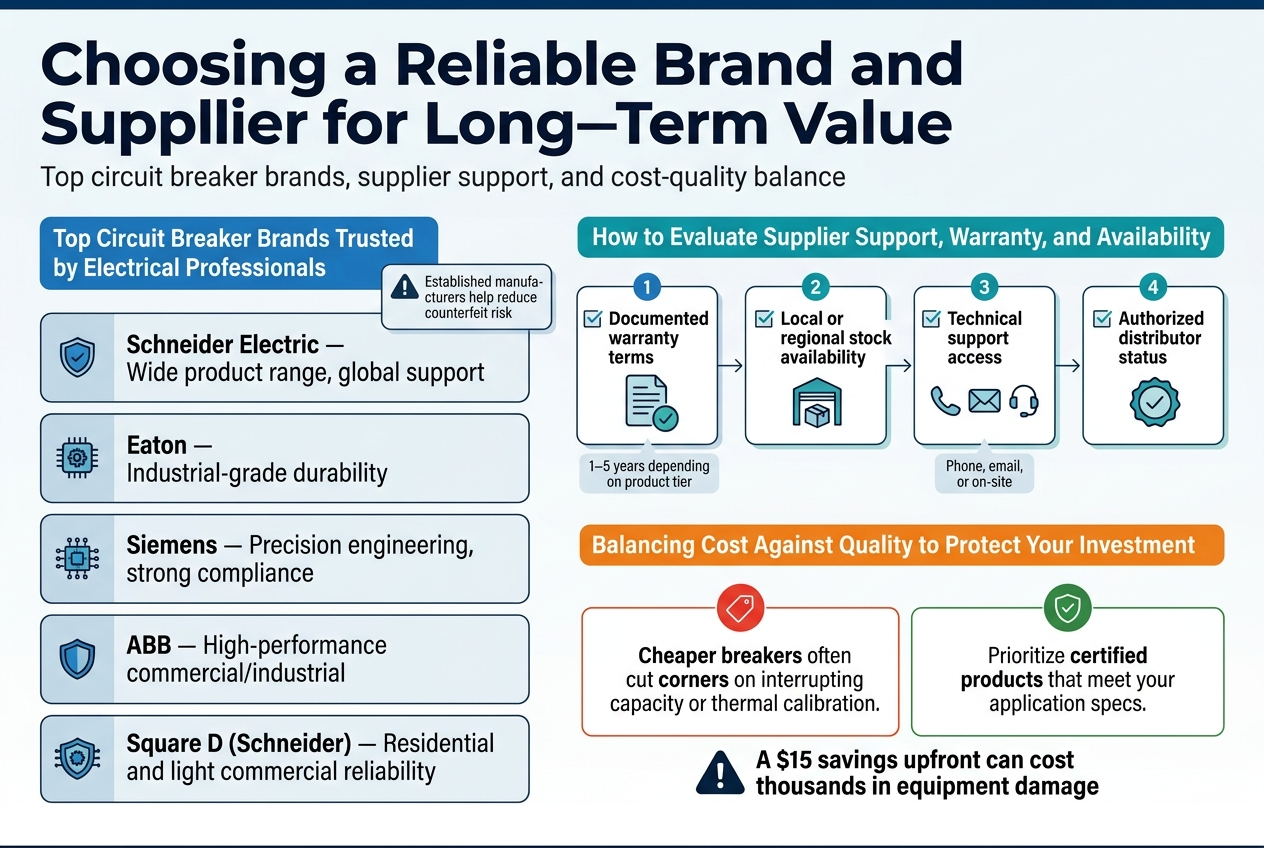
Top Circuit Breaker Brands Trusted by Electrical Professionals

Some brands consistently earn high marks from installers and engineers alike:

Brand

Known For

Schneider Electric

Wide product range, global support

Eaton

Industrial-grade durability

Siemens

Precision engineering, strong compliance

ABB

High-performance commercial/industrial

Square D (Schneider)

Residential and light commercial reliability

Sticking with established manufacturers reduces the risk of counterfeit components, which remain a real problem in electrical supply chains.

How to Evaluate Supplier Support, Warranty, and Availability

A great product means little if you can’t get replacement parts or technical help when something goes wrong. Look for suppliers who offer:

  • Documented warranty terms (typically 1–5 years depending on product tier)
  • Local or regional stock availability to avoid project delays
  • Technical support access — phone, email, or on-site
  • Authorized distributor status from the manufacturer

Balancing Cost Against Quality to Protect Your Investment

Cheaper breakers often cut corners on interrupting capacity or thermal calibration. A $15 savings upfront can cost thousands in equipment damage or downtime later.

Prioritize certified products that meet your application specs, and treat brand reputation as part of the spec itself — not just a preference.

+ Add Section

Conclusion
Create a clean, professional infographic illustration in a full-bleed 3:2 landscape layout with a modern industrial safety theme. Use a white background with deep navy, teal, and safety yellow accents, crisp sans-serif fonts, and strong visual hierarchy.

Place a large bold heading at the top center: "Conclusion"

Below the heading, arrange four wide horizontal content blocks in a 2x2 grid across the page, with clear spacing and thin dividing lines. Each block should have a colored circular icon on the left and short bold text on the right:

1. Top left block: a blue circuit breaker icon with a small checkmark. Text: "Understand what a breaker does"
2. Top right block: a teal voltage and amperage gauge icon. Text: "Match voltage and amperage needs"
3. Bottom left block: a yellow shield with certification badge icon. Text: "Check technical ratings and certifications"
4. Bottom right block: a dark navy handshake and supplier icon. Text: "Choose a trustworthy brand or supplier"

Across the lower third, add a wide warning banner with a red-orange caution icon on the left and bold text: "Do not rush. Do not default to the cheapest option."

Directly beneath the banner, add a final full-width takeaway strip with a green shield icon and bold text: "A well-chosen circuit breaker protects equipment, people, and your

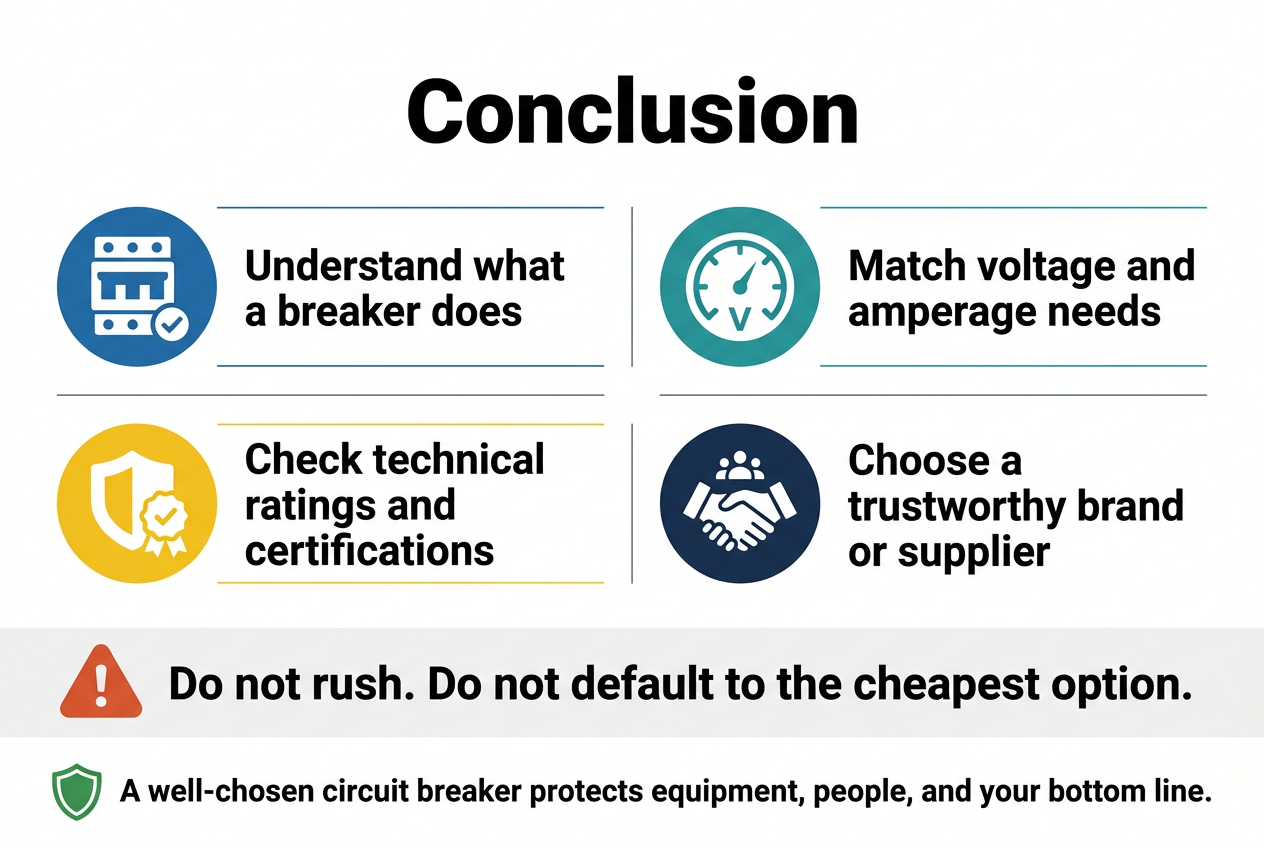
Picking the right circuit breaker does not have to feel overwhelming. Once you understand what a breaker actually does, know the different types available, and match the specs to your specific voltage and amperage needs, the decision becomes a whole lot clearer. Throw in a solid grasp of technical ratings, compliance standards, and what to look for in a trustworthy brand or supplier, and you are in a strong position to make a smart, safe choice that holds up over time.

Do not rush the selection process or default to the cheapest option on the shelf. Take the time to check the specs, verify the certifications, and source from suppliers who stand behind what they sell. A well-chosen circuit breaker protects your equipment, your people, and your bottom line. Get that part right, and everything else runs a lot smoother.

Leave a Reply

Your email address will not be published. Required fields are marked *